
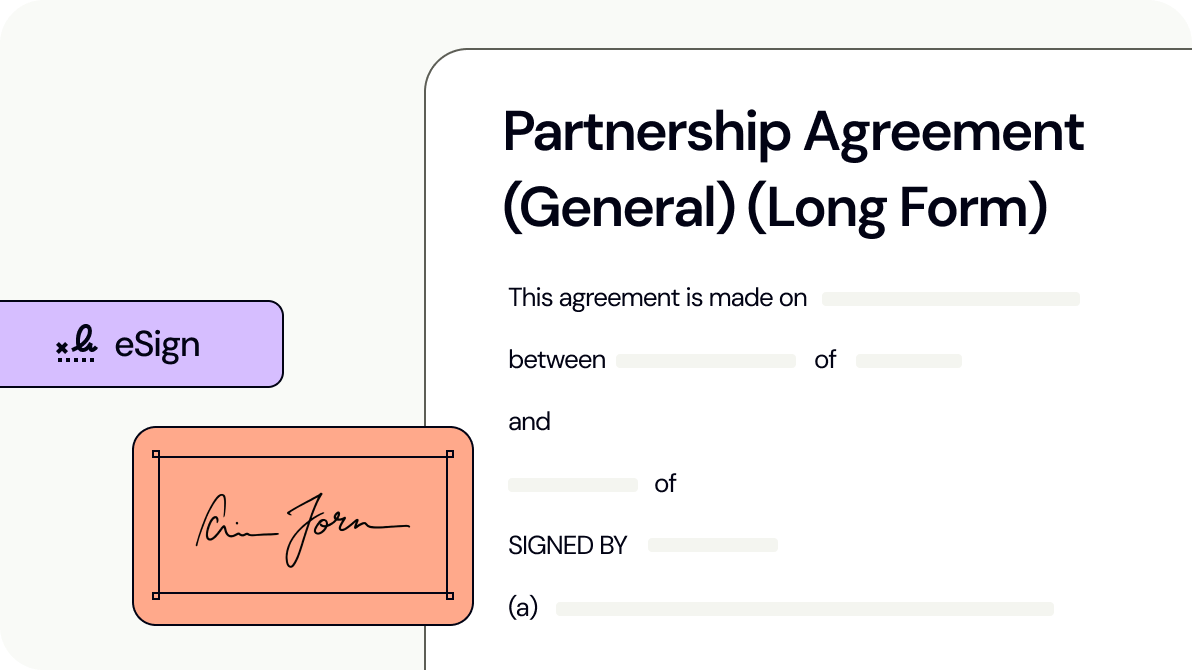
Partnership Agreement (General) (Long Form)
This Partnership Agreement (General) (Long Form) outlines the distribution of income or losses incurred by the business amongst the involved parties, as well as the terms in which the business is to operate upon.
Last updated October 23, 2025
Suitable for Australia
Create & Customise Legal Templates Online
What is a partnership agreement (general) (long form)?
What is a partnership agreement (general) (long form)?
When should you use a partnership agreement (general) (long form)?
When should you use a partnership agreement (general) (long form)?
What should be in a partnership agreement (general) (long form)?
What should be in a partnership agreement (general) (long form)?
How to create a legal document
- check_circle
Access the Document Library
- check_circle
Select the template that matches your needs
- check_circle
Customise by adding or removing clauses with assistance from Lawpath AI
- check_circle
Personalise with your headers, footers, logos, or additional text
- check_circle
Store all documents securely in your account for easy access
Frequently asked questions
Who is this agreement suitable for?
keyboard_arrow_upWhat protections does this agreement provide?
keyboard_arrow_upAre there any limitations to using this agreement?
keyboard_arrow_upHow does this differ from a joint venture agreement?
keyboard_arrow_upWhat laws apply to this agreement?
keyboard_arrow_upHow can the partnership be ended under this agreement?
keyboard_arrow_upWhat steps should be taken after signing the agreement?
keyboard_arrow_upView Sample Partnership Agreement (General) (Long Form)

The Legal Risk Score of a Partnership Agreement (General) (Long Form) Template is Medium
Our legal team have marked this document as medium risk considering:
- Partnerships are flexible business structures.
- The agreement specifies the exact financial contributions required from each partner at the outset, which could limit the financial flexibility of the business.
- Admitting new partners or handling the exit of existing ones could disrupt the business's operations and might affect the partnership's stability and continuity.
Users familiar with partnership dynamics will appreciate the document's comprehensive coverage of various scenarios, though they should be prepared for the potential complexities and shifts that such flexibility entails.
Meet Our Users
Articles about Partnership Agreement (General) (Long Form)

How To Create A Partnership Agreement (2025 Update)
A Partnership Agreement sets out all the key terms of a business partnership. Find out how to create a Partnership Agreement here.

Key Considerations for Drafting a Partnership Agreement
Thinking of drafting a Partnership Agreement? Here are the things you need to include to protect yourself and your business.

5 Things To Look For in a Partnership Agreement
Thinking about entering into a business partnership? Find out why having a partnership agreement is important and 5 things to look out for.

How to Negotiate a Partnership Agreement
Negotiating a Partnership Agreement? Here are some tips to consider to ensure the protection of you and your business.

What is a Partnership Agreement?
Want to start a partnership? Protect your interests with a partnership agreement.

Partnership Agreement Between Two Companies
A partnership agreement between two companies can help your business achieve its goals and grow your customer base.

How to Structure a Business Partnership
Ready to start a business partnership? Read this guide to find out everything you need to know about how it should be structured.

Does A Partnership Agreement Have To Be In Writing?
Think that a partnership is what your business needs, but unsure of whether a partnership agreement has to be in writing? Read on to find out.

Partner Breached a Partnership Agreement?
A partnership agreement is the foundation of a business partnership. Find out what options are available if your partner breaches a partnership agreement.
Looking for more documents?
Non-Disclosure Agreement (Mutual)
A Non-Disclosure Agreement (Mutual) allows you and another party to share confidential information while legally forbidding either party from disclosing that information to any other person or entity.
Non-Disclosure Agreement (One Way)
A Non-Disclosure Agreement (One Way) allows you and another party to share confidential information while legally forbidding the other party from disclosing that information to any other person or entity.
Shareholders Agreement
A Shareholders Agreement allows you to clarify the relationship between shareholders of your company.
Memorandum of Understanding (MOU)
A Memorandum of Understanding is a non-legally binding precursor document that allows you to record proposed terms with another party during the negotiation stage.
Confidentiality Agreement (Mutual)
This Confidentiality Agreement (Mutual) allows you and another party to share confidential information while legally forbidding the other party from disclosing that information to any other person or entity.
Partnership Agreement (General)
A Partnership Agreement (General) governs the relationship between all the partners involved in your business.
Commercial Lease Agreement (Non-Retail) (NSW)
A Commercial Lease Agreement (Non-Retail) is a legal document that can be used when a commercial property is being leased out in NSW.
Constitution (Proprietary Company)
A Constitution (Proprietary Company) is an essential and crucial document that regulates your company's activities and the relationship between your company's directors and shareholders.