
Directors' Resolution to Issue Shares (Circulating Resolution)
Create a quality Directors' Resolution document to approve share issues with instant document builder of Lawpath. Use our quick document creation tool. Try it now!
Last updated November 11, 2025
Suitable for Australia
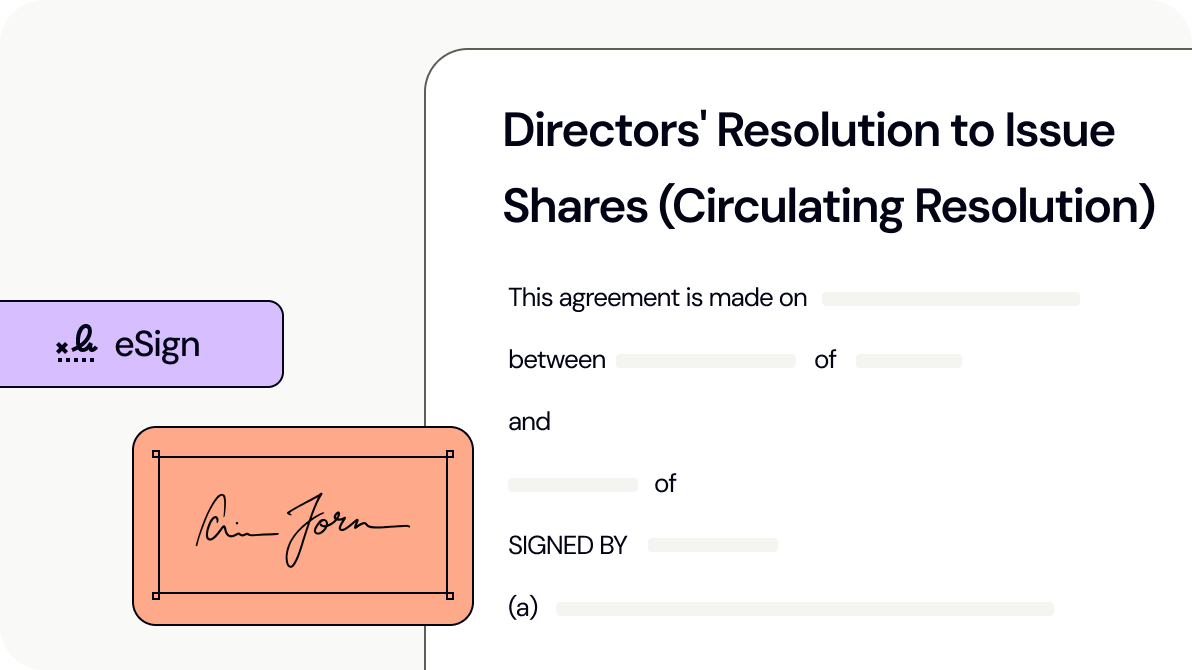
Create & Customise Legal Templates Online
What is a directors' resolution to issue shares (circulating resolution) ?
What is a directors' resolution to issue shares (circulating resolution) ?
When should you use a directors' resolution to issue shares (circulating resolution) ?
When should you use a directors' resolution to issue shares (circulating resolution) ?
What should be in a directors' resolution to issue shares (circulating resolution) ?
What should be in a directors' resolution to issue shares (circulating resolution) ?
How to create a legal document
- check_circle
Access the Document Library
- check_circle
Select the template that matches your needs
- check_circle
Customise by adding or removing clauses with assistance from Lawpath AI
- check_circle
Personalise with your headers, footers, logos, or additional text
- check_circle
Store all documents securely in your account for easy access
Frequently asked questions
Who can sign a circulating resolution for share issues?
keyboard_arrow_upWhat supporting documents are needed with this resolution?
keyboard_arrow_upCan this resolution be used instead of a directors' meeting?
keyboard_arrow_upWhat are the key risks or limitations of using this document?
keyboard_arrow_upHow should the signed resolution be stored?
keyboard_arrow_upIs this document valid across all Australian states and territories?
keyboard_arrow_upHow quickly can this document be completed?
keyboard_arrow_upView Sample Directors' Resolution to Issue Shares (Circulating Resolution)

The Legal Risk Score of a Directors' Resolution to Issue Shares (Circulating Resolution) Template is Medium
Our legal team have marked this document as medium risk considering:
- This is a standard document.
- The resolution relies on the unanimous consent of all officeholders, which could delay or complicate the appointment process if consensus is not readily achieved.
- This resolution must be carried out within other share issue processes in order to be effective.
Users familiar with corporate transactions will find the document straightforward, but should remain cautious about these gaps and consider additional safeguards or clarifications to mitigate potential risks.
Meet Our Users
Articles about Directors' Resolution to Issue Shares (Circulating Resolution)

How To Issue Shares In A Private Company
Have you ever wondered how to issue shares in a private company? Read this article if you want to learn how.

How Does a Company Issue Corporate Shares?
Thinking of having a company share issue? Find out what types exist and how you can use shares in our latest post.

What Is A Company Resolution?
Just selected a new board? Need to learn how to pass a resolution? Read on to learn more about the importance of resolutions in corporate governance.

What are Redeemable Preference Shares?
Are you thinking about issuing shares to raise capital for your company? This article will explain what you need to know about redeemable preference shares.

Can I Dilute Minority Shareholders?
Diluting minority shareholders is a controversial practice in the business world. Our article breaks down what this is, and the law behind it.

Ordinary vs Special Resolution: Key Differences
Are you looking to pass a company resolution? Do you know the difference between an ordinary and special resolution? Read on to find out more.

Do You Need Shares to Be a Company Director?
A director can choose to have shares in their company. But is this a requirement? Read our guide to find out whether a director must hold shares.

A Guide to the Corporations Act 2001 for Australian Companies
Understand the Corporations Act 2001 and its significance for Australian businesses and learn about recent amendments and more.

How Do Pre-emptive Rights Work for Shareholders?
Pre-emptive rights are important for shareholders where they want to maintain their ownership percentage. Find out more here.
Looking for more documents?
Privacy Policy
A Privacy Policy outlines how your business will use, store and collect your customers' information. A Privacy Policy is required by law in certain circumstances.
Loan Agreement
This Loan Agreement can be used by lender when offering a loan to a Borrower.
Non-Disclosure Agreement (Mutual)
A Non-Disclosure Agreement (Mutual) allows you and another party to share confidential information while legally forbidding either party from disclosing that information to any other person or entity.
Non-Disclosure Agreement (One Way)
A Non-Disclosure Agreement (One Way) allows you and another party to share confidential information while legally forbidding the other party from disclosing that information to any other person or entity.
Business Sale Agreement
A Business Sale Agreement is used to clearly set out all relevant terms of the sale when selling or buying a business.
Shareholders Agreement
A Shareholders Agreement allows you to clarify the relationship between shareholders of your company.
Services Agreement (Pro-Supplier)
This Services Agreement (Pro-Supplier) sets out the relationship between you, the service provider, and the business receiving the services. This version of the Services Agreement is drafted in favour of the supplier from a commercial and legal perspective.
Discretionary Trust Deed
A Discretionary Trust Deed is used to establish a discretionary trust in any state or territory in Australia.